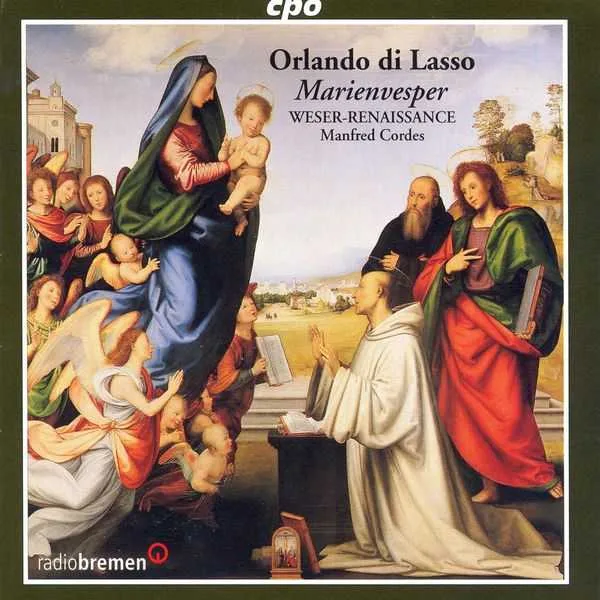
Composer: Orlando di Lasso
Performer: Weser-Renaissance Bremen
Conductor: Manfred Cordes
Format: FLAC (tracks)
Label: CPO
Release: 2007
Size: 240 MB
Recovery: +3%
Scan: cover
Introitus
01. Deus in adiutorium a 4
Selectiorum aliquot cantionum sacrarum
02. Psalm 109: Dixit Dominus a 8
Psalm 112
03. Laudate pueri Dominum a 7
Psalm 121
04. Laetatus sum a 3
Sacrae cantiones (Nuremberg, 1562)
05. Psalm 126: Nisi Dominus aedificaverit a 5
Psalm 147
06. Lauda Hierusalem a 6
Responsorium
07. Felix namque
Hymnus
08. O gloriosa Domina a 6
Antiphon ad Magnificat
09. Salve Regina a 5
10. Magnificat
Antiphon ad Magnificat
11. Salve Regina a 8
12. Benedicamus
Bremen-based Weser-Renaissance is one of the European historical-performance ensembles that has signed on to the American-spawned one-voice-per-part movement in the performance of German Baroque choral music. Its smooth, almost silky sound is attractive, and in smaller works of the seventeenth century, such as those of Schein, results in powerful, rather inward-looking performances. Here the group sets out, quoting annotator Franz Korndle, “to convey an impression of festive liturgical music such as it was performed in the Munich court chapel under Orlando di Lasso.” The degree of musicological investigation involved is impressive. Weser-Renaissance brings together some of Lasso’s most imposing motets and orders them as they might have been heard in a big, festive Vespers service during the Feast of the Assumption of Mary in August, concluding with a mighty 10-part Magnificat. Lasso is better known for his polyglot secular songs than for these more imposing sacred works, and the context — an attempt to systematically replace plainchant with more sumptuous polyphonic settings on the part of Lasso and his predecessors — is clearly laid out in the booklet and well executed in terms of the program. The problem lies in the group’s minimalistic approach. The booklet itself points out that “the performance of the liturgy was a task for all the singers of the ensemble,” which meant 15 or 20 men and a dozen boys on the upper parts. From iconographic evidence it is known that an organ would have been used as well. Yet here the listener gets seven singers, two cornetts (“Zink” in German), three Baroque trombones, and a dulcian. The forces are not up to the weighty, public quality of the music, and, questions of authenticity aside, the singers and the texts tend to get lost in the larger psalm settings and the final Magnificat. The crack about Bach’s “B minor madrigal” is applicable here, transposed to refer to Lasso, and despite the program’s strong points the disc begs for a more muscular interpretation of the music.